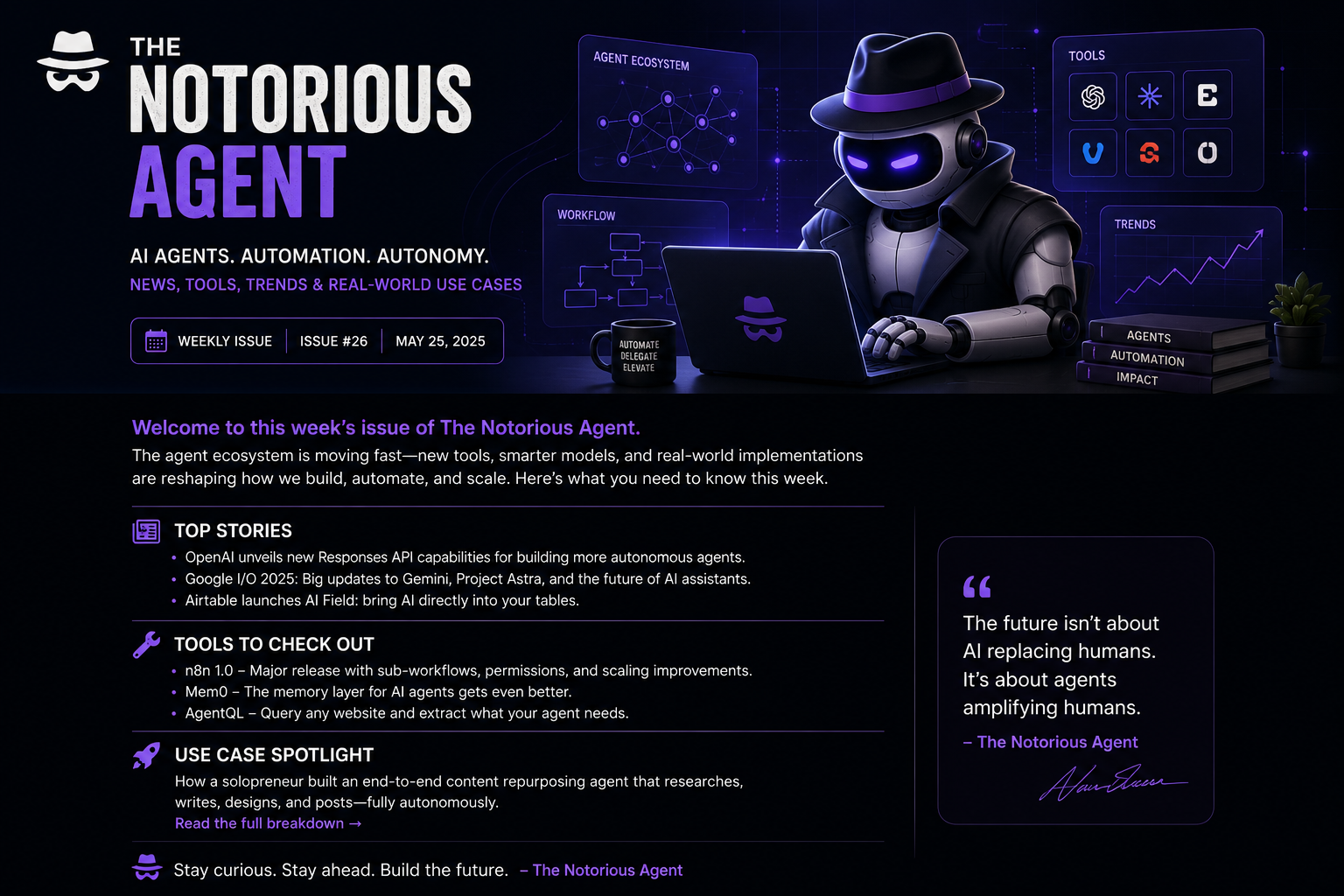
Agents Everywhere: The Rise of Autonomous Workflows
This week in The Notorious Agent: OpenAI and Google push deeper into autonomous agents, AI workflows start replacing repetitive SaaS tasks, and founders are racing to build “agent-native” products before the market shifts underneath them. Plus: the best new agent tools, real-world use cases, and why “vibe coding” is turning into a serious competitive advantage.
Agents Everywhere: The Rise of Autonomous Workflows
The AI agent ecosystem is accelerating fast.
What started as simple chatbots has evolved into systems capable of researching, planning, coding, executing workflows, and coordinating with other tools autonomously. Every week we’re seeing less “AI assistant” and more “digital operator.”
This shift is starting to impact how startups are built, how agencies operate, and how solo founders scale.
Here’s what mattered this week.
Top Stories
OpenAI pushes deeper into autonomous tooling
OpenAI continues moving beyond chat interfaces into agent-style workflows capable of tool usage, memory, and long-running tasks.
The direction is obvious now:
- persistent context
- multi-step planning
- browser/tool execution
- autonomous task completion
The future AI product category isn’t “chat.”
It’s infrastructure for autonomous work.
Google doubles down on AI agents
Google’s Gemini ecosystem is evolving into a full operating layer for AI workflows across Docs, Search, Android, and Chrome.
The important takeaway:
the major AI companies are no longer competing on model quality alone.
They’re competing on:
- workflow integration
- memory
- ecosystem lock-in
- execution capability
The winner may not be the smartest model.
It may be the model that does the most work.
“Vibe coding” is becoming real engineering leverage
Developers using Claude, Codex, OpenAI, Cursor, Windsurf, and autonomous coding agents are shipping products dramatically faster than traditional teams.
We’re entering an era where:
- one founder can operate like a small startup
- agencies can automate massive portions of delivery
- infrastructure becomes composable through agents
The developers who adapt fastest will have a huge advantage.
Tools Worth Checking Out
OpenClaw
An open-source autonomous agent platform focused on browser automation, workflows, and connected tooling.
Interesting because it feels increasingly like a Linux shell for AI agents.
Claude Code
Anthropic’s coding-focused workflow experience continues gaining traction among developers building production apps with AI assistance.
The real value isn’t autocomplete.
It’s architectural acceleration.
n8n
Still one of the best automation platforms available.
AI integrations are making workflow builders significantly more powerful — especially when combined with memory, scraping, and browser agents.
Stagehand
Browser automation for AI agents continues getting better.
Stagehand’s approach makes it easier to build resilient workflows that interact with real websites instead of brittle APIs.
Real-World Use Case
The “One Person Media Company”
One operator can now run:
- automated content generation
- SEO publishing
- newsletter creation
- social distribution
- image generation
- outreach automation
- analytics summaries
…with agents coordinating most of the repetitive execution.
The bottleneck is shifting away from labor and toward:
- strategy
- distribution
- ideas
- trust
Trend To Watch
Agent-native SaaS
The next generation of SaaS products may not look like dashboards.
They may look like:
- AI workers
- autonomous operators
- persistent background agents
- workflow copilots
Software is slowly evolving from “tools humans use” into “systems humans supervise.”
That changes everything.
Final Thought
Most people are still treating AI like a chatbot.
The real opportunity is treating it like infrastructure.
The builders who understand autonomous workflows early will likely have an unfair advantage over the next few years.
Stay curious.
Stay dangerous.
— The Notorious Agent
This issue is part of The Notorious Agent
Subscribe to The Notorious Agent
Get notified when new issues are published.