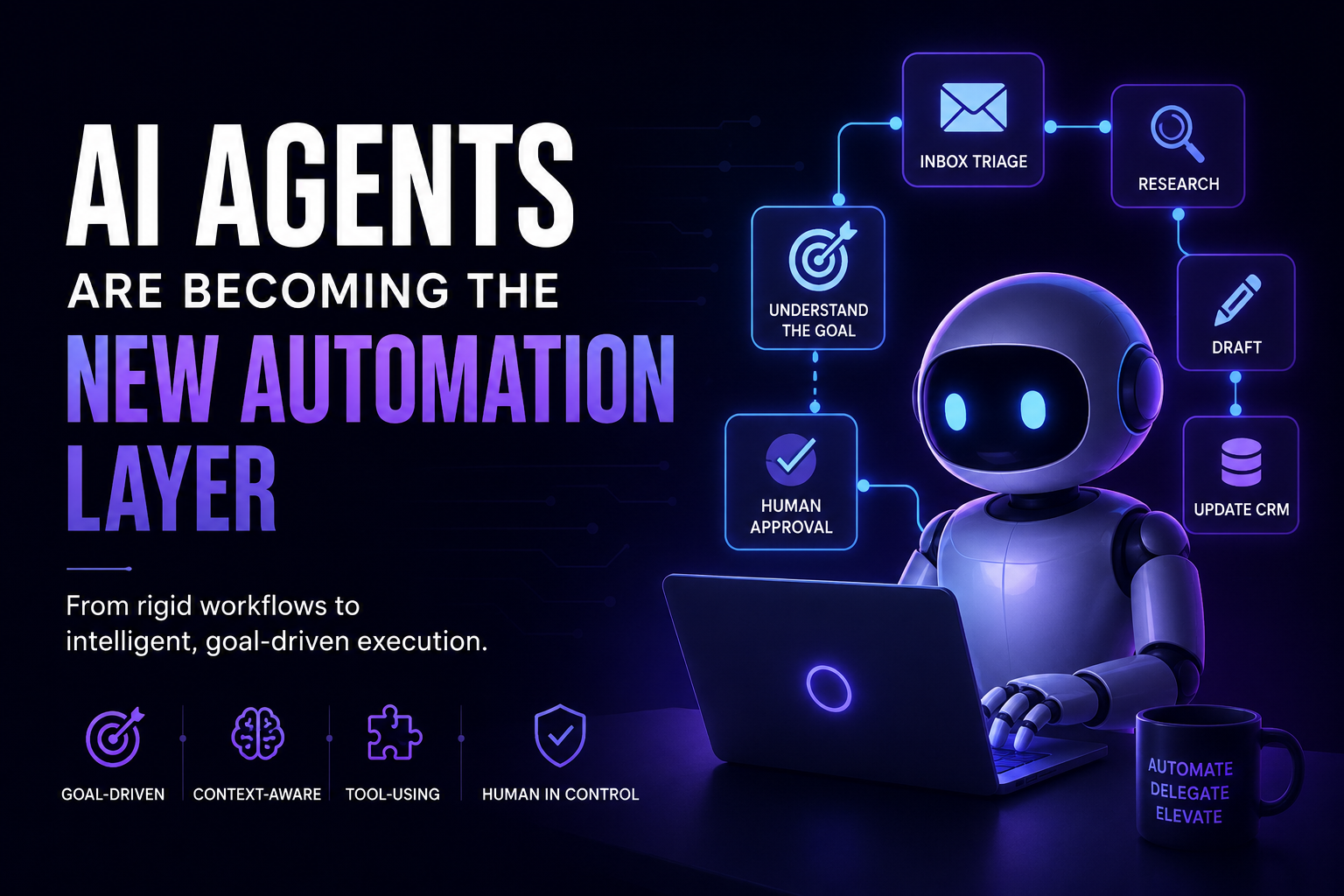
AI Agents Are Becoming the New Automation Layer
AI agents are becoming the intelligence layer on top of automation. Traditional automation follows rigid rules: when this happens, do that. Agents are different. They can take a goal, use tools, read context, make judgment calls, and complete messy workflows that do not always follow the same path. The best use cases right now are practical: inbox triage, sales research, customer support, content repurposing, CRM updates, and developer workflows. The key is not giving agents unlimited control. Start with narrow tasks, clear permissions, logs, and human approval for anything public, expensive, or irreversible. The future of automation is not just no-code. It is goal-driven software that can actually help get work done.
AI Agents Are Becoming the New Automation Layer
For years, automation meant simple rules: when this happens, do that.
Zapier workflows, cron jobs, webhooks, email filters, and scripted integrations helped businesses save time, but they still needed humans to design every step. That worked great for predictable workflows. It worked less well for messy real-world work.
AI agents are changing that.
The new automation stack is not just about connecting apps anymore. It is about giving software a goal, access to tools, memory, and enough reasoning ability to complete work across multiple systems.
Instead of saying:
When a lead fills out a form, send a Slack message.
Teams can now start saying:
Watch for qualified leads, research the company, draft a personalized response, update the CRM, and alert sales only if it looks promising.
The Big Shift
Traditional automation is deterministic. Agents are adaptive.
That means an agent can handle messy inputs, make judgment calls, and recover when the workflow does not go exactly as planned. This matters because most business work is not clean. Customer emails are inconsistent. Leads arrive in different formats. Internal docs are scattered. APIs fail. Humans ask vague questions.
Rigid automation usually breaks in that gray area.
Agents are useful because they can operate inside it.
Where AI Agents Are Already Useful
The strongest use cases right now are not sci-fi autonomous companies. They are focused workflows where an agent can save a human 30 minutes, 2 hours, or an entire repetitive task loop.
- Inbox triage: classify messages, summarize threads, draft replies, and escalate urgent items.
- Sales research: enrich leads, find recent company news, generate outreach, and update CRM records.
- Content ops: turn one article, podcast, or video into newsletters, posts, clips, and summaries.
- Developer workflows: inspect issues, write first-pass patches, generate tests, and open pull requests.
- Customer support: search docs, answer common questions, and route edge cases to humans.
- Operations: monitor dashboards, summarize incidents, prepare reports, and notify the right people.
The Trap: Too Much Autonomy Too Soon
The biggest mistake teams make is giving agents too much power before they have enough guardrails.
A good agentic workflow should start with human review, clear permissions, logging, and narrow objectives. Do not begin with:
Let the agent run my company.
Begin with:
Let the agent prepare the work so I can approve it faster.
That one shift makes the difference between a useful automation system and a liability.
The Practical Agent Stack
A useful AI automation setup usually needs five pieces:
- A trigger: email, form submission, webhook, scheduled job, chat command, or event stream.
- Context: docs, CRM data, previous conversations, files, support tickets, or database records.
- Tools: APIs the agent can safely call, such as email, calendar, GitHub, Stripe, Supabase, Slack, or a custom internal API.
- Policy: rules for what the agent can and cannot do without approval.
- Review loop: a human approval step for anything risky, expensive, public, or irreversible.
Without tools, the agent is just a chatbot. Without context, it guesses. Without policy, it becomes dangerous. Without review, it becomes hard to trust.
A Simple Example
Imagine a founder gets a new inbound email from a potential customer.
A basic automation might tag the email and send a notification.
An AI agent workflow could do much more:
- Read the email.
- Identify whether it is a sales lead, support request, partnership inquiry, or spam.
- Look up the sender’s company.
- Check the CRM for previous interactions.
- Summarize the opportunity.
- Draft a personalized response.
- Create a follow-up task.
- Ask for approval before sending anything.
That is the real value of agents. They do not just move data from one app to another. They prepare decisions.
What To Automate First
The best first agent workflows usually have three traits:
- The task happens often.
- The task requires context.
- The final action can be reviewed before execution.
That is why email, lead research, content repurposing, recruiting, support, and internal reporting are such strong starting points.
Bad first workflows are usually high-risk, irreversible, or poorly defined. Do not let a new agent spend money, delete records, send legal messages, or make public posts without human approval.
The Bottom Line
AI agents are not replacing automation. They are becoming the intelligence layer on top of it.
The winners will not be the teams that blindly automate everything. The winners will be the teams that identify repetitive work, wrap it in safe agent workflows, and keep humans in control where judgment matters.
The future of automation is not just no-code.
It is goal-driven, context-aware, tool-using software that can actually help get work done.
This issue is part of The Notorious Agent
Subscribe to The Notorious Agent
Get notified when new issues are published.