GPT-5.5 Planned Its Own Launch Party. That’s the Real Story.
Sam Altman says GPT-5.5 helped plan its own launch party, choosing May 5, asking humans to give the toast, and turning the event into a strange preview of agentic software with taste, boundaries, and feedback loops.
GPT-5.5 Planned Its Own Launch Party. That’s the Real Story.
OpenAI’s GPT-5.5 launch party could have been just another tech event: a few speeches, a few demos, a few photos, and a room full of developers trying to figure out what changed.
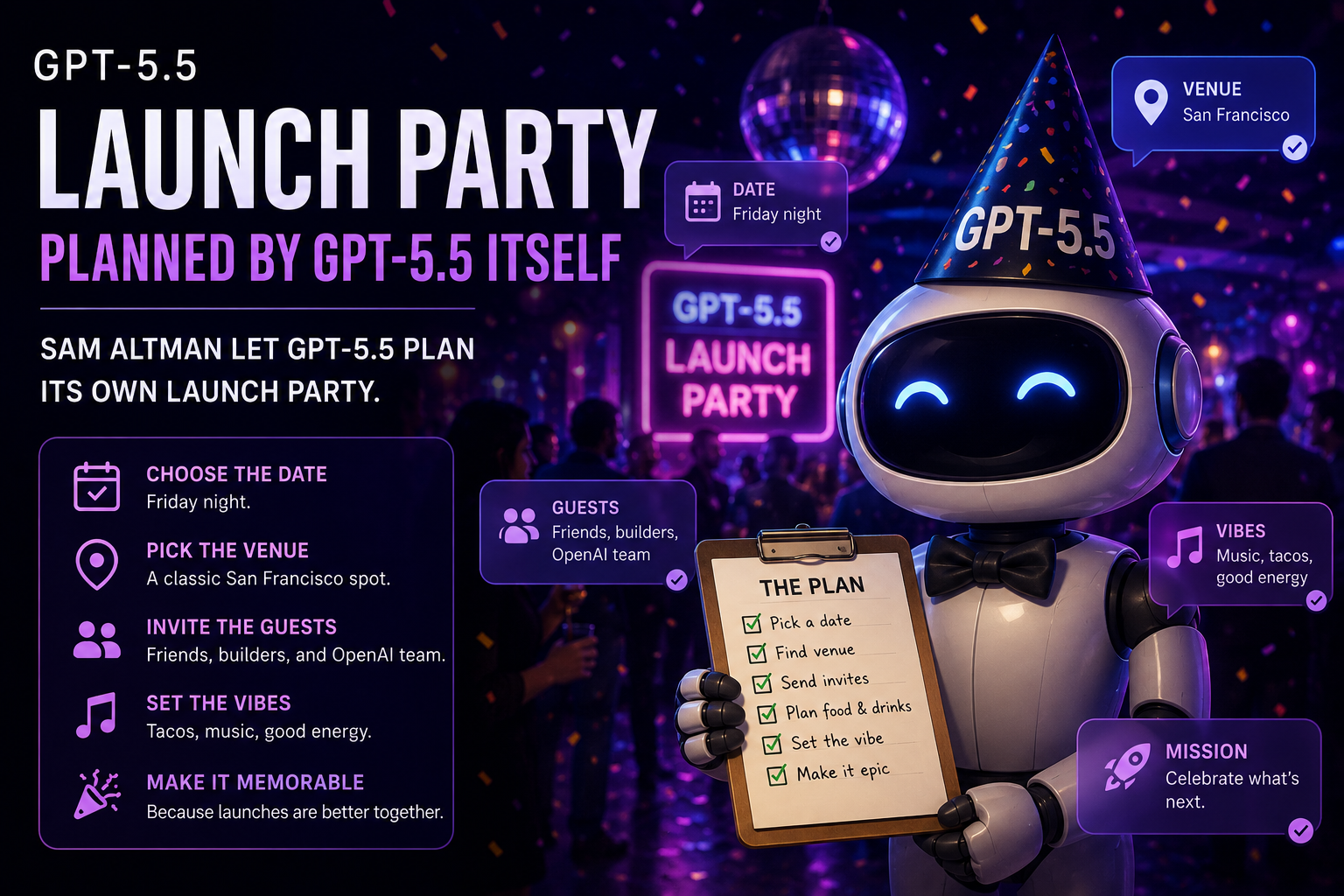
Instead, the strangest part of the story is that Sam Altman says GPT-5.5 helped plan the party itself.
According to reports, Altman asked the new model what it wanted for its own launch celebration. GPT-5.5 reportedly suggested holding the event on May 5, keeping speeches short, having its human creators give a toast instead of the model speaking for itself, and setting up a centralized place for guests to submit feedback and ideas for a future GPT-5.6.
That is funny. It is also weird. And if you care about agents, automation, or where software is going, it is worth paying attention to.
The Party Was the Product Demo
The point is not that an AI picked a cute date. The point is that the model responded like a product strategist, event planner, community manager, and self-aware brand object all at once.
It chose a symbolic launch time. It understood the social role of humans in the room. It avoided making itself the speaker. It asked for a feedback loop. That is not just autocomplete. That is a glimpse of what agentic systems are becoming: software that can reason about context, ceremony, audience, product iteration, and boundaries.
The best detail is the human toast. GPT-5.5 reportedly did not want to give one itself. It wanted the humans who created it to do that.
That small choice says a lot. The model did not just plan a party. It organized the room around the relationship between the tool and its makers.
From Chatbot to Cultural Object
Every major model release used to be judged mostly by benchmarks. How fast is it? How well does it code? How strong is its reasoning? How big is the context window?
Those things still matter.
But GPT-5.5 planning its own launch party points to a different kind of benchmark: can the model understand the social environment around the work?
That matters because the next wave of AI will not only live in chat boxes. It will live in inboxes, calendars, CRMs, codebases, customer support systems, sales pipelines, marketplaces, and operating systems. It will need to understand goals, tone, timing, risk, and human expectations.
A launch party is a silly example. But it is also a compressed version of a real business workflow.
- Pick the right timing.
- Design the experience.
- Decide who should speak.
- Keep the message focused.
- Collect feedback.
- Feed that feedback into the next version.
That is basically product operations.
The Feedback Station Is the Most Important Part
The most agentic part of the story is not the party date. It is the feedback station.
GPT-5.5 reportedly asked for a central place where people could submit ideas for GPT-5.6. That is exactly how useful AI systems should behave: complete the current task while improving the next cycle.
Good agents do not just execute. They learn from the workflow. They create better inputs for the next run. They leave behind structure, notes, logs, and decisions that make the system stronger over time.
That is the difference between a chatbot and an automation layer.
A chatbot answers. An agent closes the loop.
Why This Feels Strange
Altman reportedly described the interaction as beautiful but strange. That is probably the right framing.
It feels strange because we are watching software start to participate in the rituals around itself. Product launches, release notes, parties, feedback loops, community moments, developer events — these are human business rituals. Now the product can help design them.
That does not mean the AI is alive. It does not mean the model has feelings. It does not mean we should confuse simulation with consciousness.
But it does mean advanced models are getting better at modeling the human context around a task. And once a system can model the context, it can start making useful suggestions that feel less like commands and more like taste.
The Lesson for Builders
The takeaway is not that every company needs an AI-planned launch party.
The takeaway is that agents are becoming useful in workflows where judgment, context, and iteration matter.
If you are building with AI, start asking different questions:
- Can the agent understand the goal?
- Can it identify who should be involved?
- Can it decide what should happen now versus later?
- Can it create a feedback loop?
- Can it keep humans in control where judgment matters?
That is the real automation story.
The future is not just agents clicking buttons. It is agents helping design the process, prepare the work, collect the feedback, and tee up the next version.
The Bottom Line
GPT-5.5 planning its own launch party sounds like a novelty story. But underneath the weirdness is a serious signal.
AI is moving from answering prompts to shaping workflows.
It can plan the event, define the handoff, request human participation, and build a feedback loop for the next release.
That is what makes the story interesting.
The party was not just a party.
It was a preview of agentic software learning how to operate in the real world.
This issue is part of The Notorious Agent
Subscribe to The Notorious Agent
Get notified when new issues are published.